Friday, March 13, 2009

Little Ideas (with large impact) = A Big Idea


Jan Chipcase of Nokia. Refreshingly insightful. I want his job!

While all the talk of "human-centered" design seems to be spewing out of people's mouths, keyboards and pens like it's going out of style, Jan actually reveals what it is about the human experience that gives technology it's value to us. Additionally, I found this really inspiring in the way he looks at technology from a global context.


Monday, February 16, 2009

TWITTER: Superbowl Timeline

NY Times Twitter Superbowl Timeline was a pretty cool idea showing what people twitter from what part of the country at what time during the game.

Apart from the fact that it is just a cool simple idea, it is interesting to see a whole country’s public consciousness on display over a live event. At the same time, it’s a bit scary to see a big nation being this synchronous in a medium that is all about variety and heterogeneity.


Also interesting: check out the separate timeline for which ads got the most feedback on twitter during commercial breaks.


Monday, December 22, 2008

Social Media Predictions 2009

With the economy in a slump and budgets being cut in traditional print and TV advertising campaigns many will be looking to the Web 2.0 world to reach their constituents.

So what should be on your Web 2.0 radar for 2009?


1. Social Media Maturation


Social Media will cease to be such an "experimental" field in marketing and will start to become part of the main core of good campaigns.

2. Open Standards for User Data

The future of social media is user's owning their data, deciding who to send it to. Look for more companies that currently host the user's identity to have less control over that, as things like Open ID take over and more companies try to compete by giving users more control over themselves. Look for ways users can own their own data, and companies that might offer that, sort of like a personal information bank. The biggest innovation will be the opening of social networks so that they can exchange profiles, social relationships, and applications. As such, companies need to think about how they will "open" up their businesses. For example, rather than create your own community, could you leverage a community that already exists on MySpace, Facebook, or LinkedIn?”

3. Mergers/Acquisitions

Mergers/acquisitions for some of the weaker social network and Web 2.0 platforms. Investors will manage fewer entities but will commit to seeing them come to market.

4. Location Based Services

Location based services will proliferate and become more useful to the end user. As a user, I have to say, I love that my iPhone apps know where I am. And the value of location services is only beginning. Bring it on!

5. Aggregation Services

Aggregation services will change from just "drinking from the fire hose" to become very specific aggregation tools, perhaps with very specific use cases. The amount of data we can consume as humans stays limited, but filtering that data to become useful for specific reasons is not only something that's doable, it has an incentive... targeted customers. Those customers might be businesses or consumers, but the days of shooting from the hip with a shotgun approach are quickly ending. Shooting from the hip will stay, because it's fast, easy and cheap (and will get faster, easier, and cheaper) to build web applications. But being fast doesn't mean you're being smart.

6. Social Media Business Model

The next phase of Web 2.0 will be proving there's a business model behind social networks that is financially viable. People don't like being advertised to, which is in part, what social media is about....the soft sell, or "awareness creating." Yet traditionally, ads have paid for wonderful services and programs that we all enjoy. So its finding a balance that makes sense.

I personally hope the words "Web 2.0" and "Social Media" begin to get phased into newer concepts as they have become part of the ubiquitous fabric of the landscape. This past year we have seen the relentless ongoing media hyping of these trends and terms and this has created a bubble effect... Many other areas deserve our attention.

Hoping this next year brings real business value and success for those that have percevered in this space.

Warm Holiday Wishes

Tuesday, October 21, 2008

MEASUREMENT: Engagement Metrics


The whole debate over the definition of engagement and its associated measurement seems to be somewhat overdone.

Its just that now, we are not living in the more simplistic world of CPC, CPM and CPA style calculations. Engagement has multiple dimensions to it in terms of metric components. While every company must sit down and determine what they deem to be the proper measurement approach, here's one generic formula that can provide a starting point for this exercise.

Audience Engagement is a function of the number of clicks a visitor generates at a site, the amount of time they spent at the site, the frequency at which they return to the site, and their loyalty to the site as a member of the category for all of the sessions to that site during the reporting period. This online behavioral measurement should be looked at in combination with qualitative research data (such as surveys, polls and focus groups) to provide validation and deeper context to your reporting analysis exercises.

Σ (Ci + Di + Ri + Li + Bi + Fi + Ii)

The components of the calculation are:

Click Depth Index: Captures the contribution of page and event views
Duration Index: Captures the contribution of time spent on site
Recency Index: Captures the visitor’s “visit velocity”—the rate at which visitors return to the web site over time
Brand Index: Captures the apparent awareness of the visitor of the brand, site, or product(s)
Feedback Index: Captures qualitative information including propensity to solicit additional information or supply direct feedback
Interaction Index: Captures visitor interaction with content or functionality designed to increase level of Attention the visitor is paying to the brand, site, or product(s)
Loyalty Index: Captures the level of long-term interaction the visitor has with the brand, site, or product(s)

Using Comscore data, here is an example using news sites:


Using Audience Engagement (AE) we can say with a high level of certainty that a greater percentage of Internet users find CNN more engaging than MSNBC and Yahoo! News.


Final Thoughts
By establishing standard engagement metrics I believe that brand advertisers, advertising planners, and marketing managers will be able to use this data to make better decisions during the ad planning and media buying process. More importantly though, we can begin to look at the customers relationship with a brand in a more holistic way.


Friday, August 08, 2008

Great Products in an Uncertain World


To achieve success in today's ever-changing and unpredictable markets, competitive businesses need to rethink and reframe their strategies across the board.

Large companies today often get too caught up in chasing revenue and lose touch with what their customers actually want.
Smaller startup's today are passionate with ideas, adrenaline and dollars-signs-in-their-eyes - but they often go to market with no ability to adapt and listen to their users. They cannot "sense and respond" to evolve their products.

1. Unrelenting Chaotic Marketplace

Today's business climate in virtually every segment is in flux. Uncertainty and confusion has arrived. Technology and social trends have turned many business models either upside down (Music) or into some state of radical transformation (Travel). I believe that this is not just a phase, but that you can pretty much assume that things will continually be continually changing. And you can not "easily" predict it. While some can (Steve Jobs), the vast majority of us will struggle to understand where things will be just one year from now. We are living in a new world of complexity, transformation and disruption.

The good news is that change brings opportunity. Smaller, newer and smarter players can challenge industry norms and seize the day. The key now is to change your ways and embrace the new world order.


2. Companies Must Adapt

Companies must develop a new set of organizational competencies: qualitative customer research to better understand customer behaviors and motivations; an open design process to reframe possibilities and rapidly translate new ideas into great customer experiences; and agile technological implementation to quickly prototype ideas, getting them from the whiteboard out into the world where people can respond to them.

Pragmatic Marketing is well known for its popular "Market-Driven" approach to building products. When applied this can be somewhat verbose and can take a "manufacturing view" of building products which is more suited for larger product or software companies (HP, Kodak, Sun). This process is holistic and weaves together all key driving requirement inputs (Sales, Marketing, User, Competitive, Consumer Research) into feature sets and release plans. But this verbose process is increasingly getting difficult in today's fast moving and dynamic consumer market where it’s hard to guess ahead of the curve what the right product should be.

My recommendation is that we take queues from some of the new companies that are doing it right. Flickr continues to be a great example of a better way to do this. Yahoo originally had their own "Yahoo Photo" service and this could not keep up with sheer velocity of the and new aggressive Flickr (they wisely bought them). You can go to Flickr's about page and get a sense of how they do this. They start with a vision, strategy and a process to get there. Then over time the feature sets evolve to support this. This is truly an agile product process.


3. Evolving Your Approach

My point is not that companies need to scrap what they are doing today, but more, rethink think a bit and particularly the part where you incorporate customer insights into the design process.


Outside-In - Tim O’Reilly has a term called “Outside-In”.
This is where the experience is a key driving force into the product process. The converse of that is where a brand wants to take itself into the market (Inside-Out approach). The key is to take a more balanced approach of both. Bottom line, experience can and should be a major driver in strategy.


Human Complexity - Think of the messy complexity of real human life.
We need to treat people more holistically, treat them as people not as some market opportunity or as an over simplified market segment. The user is not only a potential customer and revenue opportunity but have all the depth of a real person with many levels of motivations and goals. Where we would traditionally do user centered design and surface a user’s Goals and Tasks. It’s important to go even further here and understand their daily life realities and explore factors such as emotions, context and real meaning.

Key to achieving this is studying your customers as real people through qualitative and quantitative research. I have found that very few startups are doing this today.


Product Simplification - Sometimes, Products are structured, the way the organization works.
Think major government, bank or a telco. Have you ever interacted with Verizon and they deal with you a separate person across their different divisions and groups (Wireless, Broadband)?

Another pitfall is cramming complexity into one product, instead of keeping simplicity as a main theme. Companies keep bloating there offerings thinking more equals better. Someone once said “Simplicity is complexity resolved”. Google is a great example of a company that has become very large in scope, but still maintains a simple (almost no graphics) user start experience.

Because consumers are very busy and fickle they prefer to deal with brands that have more usefulness (utility) and have limited brand experience. This is one of the lessons from the Web2.0 phenomena.

Embrace the complexity in the market. Deliver radically simple (sorry Eloan).

Design as Activity - Design is often thought of as ascetics or the rock-star savior. It’s the creation of "that thing" that the kids with cool shoes do. And we do it every now and then when its needed. Design should be a core competency, and a facilitation role that delivers experiences. Business, Technical, Creative and User’s are all involved in the design process. Great design is felt, and has a wowing effect, but also can be seamless and beautifully subtle. Great products also repeatedly Wow us with each release (think iPod, which delights us continually overtime).

Design is a core competency.


Final Words

Successful companies should be adapting the ways they think about their products and customers. Embrace complexity by staging releases over time to reveal a greater vision. New technologies and highly iterative roadmaps make it easier to start to create more consumer centric experiences.

Do you have a product process that allows you to continually deliver "wowing" customer experiences?


Tuesday, July 22, 2008

BOOK: Groundswell


Groundswell is the best book on social media I've ever read, and it may be the best book ever written on the subject.

Here's why:

1. It's current. Books on social media by nature almost can't be current. Everything is blogged or twittered one day, forgotten the next. Yet this book has some staying power, and you can give it to your boss or your client feeling reassured that even if they don't get around to reading it for six months, it'll still be valuable when they do.

2. Charlene Li and Josh Bernoff write the book like authors, not analysts, even though there's plenty of number-crunching with meaty take-aways. The human stories that illustrate each point provide protagonists you can identify with.

3. If you're new to social media, you'll appreciate a lot of the how-to material. If you're a pro, you'll appreciate how to do it even better and some of the more advanced material in the book.

4. The technographics, discussed frequently on the Groundswell blog and in the analysts' presentations, are useful. If you read the book, the technographics tool on the Groundswell site becomes even more intuitive, although the site has enough info to get value out of it. It's amazing how much Forrester's giving away.

5. You get breakdowns of return on investment metrics of an executive's corporate blog, ratings and reviews, and a community support forum, figures which are hard to find elsewhere and can provide good benchmarks for related scenarios you may encounter.

6. The book offers thoughtful answers to some of the more important questions. How can you tell if a new technology has staying power? Why do people participate with social media? How do you energize your customers? When should you use blogs, social networks, and other media technologies?

While we may think we are motivated by hearing about the successes of others, believe it or not, little is more encouraging or energizing than learning about or witnessing another's failure, especially if it is an expert who is failing. I wish there were a few more failures to learn from along with the hits.

Outside of that though, this book's an outright success, one I'll be recommending to colleagues, clients, and anyone else who will listen.

Thursday, July 17, 2008

SKILLS: Mastering Web Research


Sometimes you have to ask yourself, am I ruling the internet, or is it ruling me?


In today's world you can easily get overwhelmed with the amount of information and conversations - that seem to be increasing exponentially. Part of my work has me continually polling the internet for both daily news and also my project focused research. I thought I would give some insights into how I do this, and you too can enhance your research approach.

Step 1: Set Up Google Reader

There are a myriad of RSS aggregators out there that you can use as your information hub. Many large companies use Attensa for its enterprise level tools and integration. For our purposes Google Reader works best. It’s free, it has easy-to-use keyboard shortcuts and, being a Google product, it naturally features strong search capabilities.

Step 2: Set Up Folders

Actually, you’re only going to set up two folders. Google Reader allows you to create folders and then designate in to which folder you drop each new feed. Label one folder “Daily.” You will use this for only the top 10 blogs that you must read every day. These should be blogs that have the most relevant posts for your company on a regular basis. Label the second folder“Archive.” This contains all of the other blogs that you subscribe to. Make sure to assign every single blog that you subscribe to one of these two folders. You can always change these designations as your blog list evolves.

Step 3: Populate Your Reader

This tactic is only as effective as the content you’ve subscribed to, so this step will take some time. Now that you’ve got a place to read all of the content you subscribe to across the social Web, you’ve got to make sure that relevant content is finding its way in to your reader. Let’s assume that you currently don’t have an RSS reader or subscribe to any business related blogs. The idea here is to identify as many relevant blogs as you can find and add them to your reader. You want to find content related to your industry, your company or your competitors. Keep all of these in mind as you decide which search terms will help you find the most relevant results.

The blogosphere alone consists of hundreds of millions of blogs. In addition, there are millions of videos added to YouTube daily, not to mention the millions of tweets, forum posts and shared photographs that make up the evolving social media community. You won’t be able to follow it all, and frankly, you don’t need to. Depending on your business, there are probably less than 20 blogs that generate the majority of conversations in your niche. Our goal here is to find and follow the biggest blogs in our community and also try to catch pockets of conversations from other sources as well. There are a few tools that will help you get started:

Discussion Boards

For discussion boards, you can use Boardtracker or Omgili to conduct a search of conversations about your brand, your competitor, or your niche across several different forums and then subscribe to ithe results via RSS. Put the resulting feeds in the archive folder.

Summize

Summize is the best Twitter search engine available. Twitter is a great tool for monitoring general chatter. Type in your search term (industry buzzwords, your brand or your competitors), conduct the search (making sure to limit your language parameters as appropriate), and then subscribe to the RSS feed for the results. Place the keyword results in your daily folder and archive the other searches.

Google Blog Search

Google Blog Search helps you to capture some of the conversations happening in the blogosphere about your brand. The only problem is that this search will generally include a lot of splog results (spam blogs automatically generated by keyword searches). You can use Twingly, Icerocket or Yacktrack as three additional alternative blog search engines here. Also, if you already subscribe to Google News Alerts, you can have those results sent to you via RSS instead of in email as well. Search terms should include your company’s name, products, key executives, competitors and buzzwords in your niche. All of these should be put in the archive except the one with your company’s name.


Step 4: Search… Smartly

The hard work is behind you. You’ve subscribed to a bunch of blogs, you’ve determined which 10 feeds are the most important, and you’re ready to invest your 10 minutes a day. Here’s what you do:

Spend 5 minutes skimming the blogs in your Daily folder. Use the “J” and “K” keys to quickly cycle back and forth between posts. For a list of other Google Reader keyboard commands. check this out. Click on the most important posts. If you don’t subscribe to the blog, then do so.

Next, go to the search bar at the top of Reader. Conduct a search for the keywords you used to determine the blogs you found in the beginning of step 3. Instead of searching the entire blogosphere every day, all you have to do is a quick keyword search in your RSS reader to see if any of the blogs in your archive folder are mentioning your company, your industry your competitor. Using the Google Reader keyboard shortcuts, you should be able to cycle through and skim these posts pretty quickly, only stopping to read the most relevant content.

Step 5: Share

Now that you have a sense of the conversations, you can do two things with the posts you find. First, you can email them to your colleagues using the bar at the bottom of each post. Second, to empower your team, you can ask other staff to set up a Google Reader account. But instead of having them go through the process outlined in Step three, you can export your list of blogs (called an OPML file) and share it with your colleagues.


Final Words

By effectively monitoring the most important content and conversations about your interest topics, you’ll be better positioned to achieve your goals and manage your time better. I start every day by checking what's happening and then catching up more sporatically over the course of the day. Of course new tools are on the horizon that are going to make things easier, smarter, faster, but for now, one must have skills in research. Please share what techniques are working for you.


Monday, July 07, 2008

SOCIAL: Online Conversation Models


Online Conversations Are Evolving

It wasn't long ago that to be a credible participant in social media one only had to have a decent blog and keep it updated fairly regularly. The rise of social media was an astonishing and novel enough development that most people still don't blog today, despite the enormous influence that blogging and other forms of social media continue to have. One reason is that blogging takes time and takes some skill, both in writing and using blogging tools effectively. Another is the rise of online social networking sites like MySpace, Facebook, and Hi5, which add a personal dimension to online interaction that many find more rewarding and relevant for them.

But just like blogs made two-way conversations on the Web relatively cheap, easy, and quick for the masses compared to previous methods (such as personal Web sites), conversational models on the Web have continued to evolve. Recently, microblogging and social aggregation platforms like Twitter and Friendfeed have emerged to offer alternative models that are compelling for a number of significant reasons. For one, contributing to them doesn't take much time. To achieve this, they either have radical limits on the amount of content that can be posted at a time (140 characters for Twitter), or they do the posting work for you and automatically centralize your social activity on other sites into a single feed, as in the case of Friendfeed. They also tend to work very well on mobile devices -- an incredibly fast growing channel for experiencing anything on the Web these days -- as well scale conversation well, are extremely easy to use (even easier in general than blogs), and allow you to keep track of a large numbers of contacts socially.

And vitally, both Twitter and Friendfeed are open platforms, not just mere tools. A key factor in their success is that they offer open APIs to allow others to add the features and capabilities that are missing for various specialty needs that would otherwise clutter the product for many users. This creates a far richer overall feature set than any single product could offer on its own, while at the same time leveraging the innovation of the user community. Blogs have been able to do something similar with badges, widgets, and plug-ins for some time but haven't seen the same directed results as we'll see below.

The sheer volume of 3rd party add-on activity for these platforms is impressive. Best-of-breed applications like Twhirl for Twitter (and now Friendfeed) and AlertThingy for Friendfeed extend these new social media experiences onto the desktop and provide real-time monitoring of your "Twitterverse" or friend's feeds. To get a full sense of the depth and scope of the innovation of the Twitter community, which is certainly still a niche compared to the blogosphere, though an increasingly impressive one, you have only to look at some of its more compelling 3rd party applications:

12 Twitter Applications

Summize - A power search engine for scanning Twitter conversations for information
Twitter Charts - Detailed analytics of your Twitter activities along many different metrics
TwitterFeed - Link your blog activity to Twitter
TwitterGram - Post MP3s into your Twitter conversations
TweetBurner - Combined with twurl.org, this application shows click through analytics on your Twitter links as well as overall Twitterverse stats
TweetWheel - Analysis your Twitter account's social graph to understand the connections between your followers
TwittEarth - A 3d animated globe that shows activity in the Twitter public timeline in near real-time
Twitt(url)y - A link aggregator that reports on link activity within the Twitterverse, a sort of Techmeme for Twitter
TwitSay - Use your phone to post to Twitter via a voice message
TwitterSnooze - Turn off a chatty user temporarily and bring them back automatically later
Twistori - An interesting dashboard that displays the expression of key memes from the Twitter public timeline, creating a sort of global collective intelligence
Twubble - Many new Twitter users have trouble finding users to follower, this tool helps finds new contacts you might care about

Understanding How Conversations Are Changing

The challenge today is that while the size of individual contributions to online conversations is getting smaller, the frequency of conversations are increasing on these new social media platforms. Making this point, Sarah Perez over at Read/Write Web wrote this morning that there are too many choices, and too much content. Users of the latest social media tools are far more likely to post several times a day, more likely dozens of times, each one forming a new conversational beachhead. This can be overwhelming, but it can also be enormously stimulating and rewarding, as a form of collaboration, cross-pollination, brainstorming, serendipity, news gathering, and countless other activities provide one with a continuous connection to the broader world.

What conversation dynamics are working well for you today on the internet?

Thursday, May 22, 2008

SOCIAL: Aggregation & Syndication


Centralizing and Syndicating Your Online Life


It's beginning to look like 2008 might be the year of the social aggregator as users begin to employ these emerging new tools to better manage and track their various online relationships, both personal and professional. The introduction of these new Web applications, such as Friendfeed, Socialthing!, Spokeo, Second Brain, and Iminta, are making it easy for users to keep track of what their friends are doing online while simultaneously demonstrating that there are compelling alternatives to being social online without having to, say, actively maintain a Facebook account. In fact, that's the very premise of this new type of social Web utility, which automatically tracks a user's public activity at sites around the Web including blogs, Flickr, Twitter, del.icio.us and so on, and creates a single convenient feed for others to consume and track.

I've been evaluating a number of these applications over the last few weeks and so far Friendfeed seems to be one of the best offerings in this space and also supports one of the widest array of online services, with Socialthing a close second. Friendfeed currently monitors and aggregates one's social activity on 28 different services at the time of this writing, putting the result into one clean activity stream with a matching Atom feed. While the latency on some of the services Friendfeed tracks isn't always great -- del.icio.us bookmarks seem to take a good long while to show up for example -- the integration ranges from the workable to the robust, with surprisingly good support for Twitter's hashtags for example. Services you also might not have previously considered aggregating socially are also offered by Friendfeed including your Gmail status message, Netflix rental queue, and your LinkedIn activity.

Darn, Just when we thought we were catching up with all the paradigms. ...

Monday, April 07, 2008

SOCIAL: Viral Loop Methodology


Remember the days when viral meant "send to a friend"?, well now its becoming a full blown tactic that may be the key to your success.

Some of the most successful viral apps have spent as much time on their viral formula as on developing the app itself. While this is more a facebook phenomena today - it will soon be key across the entire web network as opensocial and widgets get more established. Here is the beginings of a methodology for measuring virality and what it means for an app to “go viral.”

K-factor and R-zero

Terms like “K-factor” (contagion) and “R-zero” (reproduction rate) are often used to describe the growth rate of viral apps. These terms come from the fields of medicine and biology — they’re originally intended to describe the spread of of viral diseases, but they’re nice analogies for how web/SN apps grow. Some would even describe widgets and apps as “diseases” that have “corrupted” popular social networks like MySpace and Facebook! If you are interested in viral apps, read on!

Whether we’re talking about apps or diseases, the key factors in determining virality are the same:

  1. Distribution: how many people, on average, will an “infected” host make contact with while the host is still “infectious”?
  2. Infection: how likely is a person, on average, to also become “infected” after contact with a viral host?

If you multiply these factors together, that’s your viral growth rate (or “K” or “R-zero” or “viral coefficient”). The product of these factors answers an important question:

How many people will be infected by a single viral host while the host remains infected?

With real-world viruses, the infectious period has very dramatic outcomes. E.g., a host remains infectious until either the virus kills the host or until the host’s immune system fights off the virus. If K=1, then the host basically passes the virus on to one new person before either the host dies or the virus is expelled. Either way, if K=1, then the host exactly replaces him or herself in the population of infected people before becoming non-infectious.

Hopefully, the growth of social apps will never involve physical death or illness! Instead, we would consider a host to be “no longer infectious” if they either uninstall the app or stop actively using the app. Using that definition, an app with a K-factor of 1 will have a userbase in steady-state - no growth, no decline, just flatline; where every current user replaces themselves before leaving the userbase. "K>1" means an app is growing its userbase virally (exponentially). And, conversely, if K is less then 1 then the userbase is decaying exponentially.

Assuming that you've got a reliable way of collecting metrics, here’s a list of four key levers for achieving viral app objectives. You can design, measure and optimize these key success metrics as part of your overall viral plan.


4 Viral App Control Levers


  1. Increase the percentage of “active hosts who actively make contact with uninfected people
  2. Increase the contact rate for each active host (average number of contacts per time period)
  3. Increase the duration of each active host’s infectious time period
  4. Increase the likelihood that contacts turn into infections (i.e., infection conversion)

Some example methods for optimizing virality:

1. Active Hosts

  • Require users to invite more people to join the app before they can view/use the app. Typically paired with premium or high value content. (eg: “Invite 10 friends in order to unlock this pr0n video in high-definition” or “Invite 15 friends to see how who has a crush on you”). Some users complain about this tactic, but you may be surprised at how many users will effective.
  • Opportunism — you can’t always predict how people will utilize an application, so give your users multiple ways to share your app. Ideally, every app pageview should contain one or more ways for a user to share the app (and thereby become an active viral host).

2. Contact Rate

  • Create incentives for inviting more people. E.g., “invite 10 more friends to level up and become a Black Belt Ninja”
  • Specific requests tend to work better than vague encouragements. E.g., don’t just ask users to “please invite friends”, specifically ask for a number, “invite 10 friends”
  • Simplify, simplify, simplify. If your #1 goal is to go viral, then that should be the #1 action-request that “pops” out to a user. Make it easy to invite more people. Utilize address book importers. Auto-select large(r) distribution lists for invitations. Basically, minimize the amount of hunting-and-clicking it takes to get a user through your invitation process. Ideally, it should just be 1 click.

3. Activity Duration

  • User-to-user messaging is a great way to keep users coming back to an app. If pokes, walls, comments or private messaging fit into the context of your app, you should seriously consider building those in.
  • User generated content and media — in general, apps that have some form of UGC/media built into them (music, photos, videos, drawings, etc.) do a better job at drawing repeat visits. I’d also group collaborative filtering functionality in this bucket — e.g., ratings, rankings, top playlists, “most viewed” lists, etc.

4. Infection Conversion

  • Social context — when you’re writing the content/copy for your app invitations, be sure to keep in mind the fact that all your app invitations are occurring in the context of a social relationship between two friends. Use that knowledge as you phrase every call-to-action and craft each sentence to reinforce the social relationship and play on influence mechanisms between these two friends.
  • Images and buttons — beyond writing the actual content/copy, app authors should also experiment with design and layout of their invitations. Some top tips include: use buttons instead of plain text links; and use images of people to draw the eye.

Of course, the list above is not exhaustive, it’s just a sampling of top-of-mind viral engineering techniques.


Sidenote on app metrics

Note that this also implies that in order to affect any of these, you, as an app developer, need to be able measure each of these stats for your userbase. You can’t tell if you’re driving any of these numbers up (or down) until you know how many contacts/invitations each of your users sends out per day/week/month that they have the app installed; how many days/weeks/months each of your users tends to keep the app installed; and what the conversion rate from a contact/invite into a new infected user is.

Collection and analysis of metrics for social apps is a meaty topic in and of itself, so we’ll leave that for another day. But for now, it should suffice to say that it’s really important to have an effective way to collect statistics on what your users are doing with your app!


Summary

So good luck to all you app developers out there seeking app virality! As you can see, none of this stuff is not “secret sauce” or anything — you can readily view all of these techniques in action on Facebook, MySpace and other social network sites today.
If you have other top tips for tweaking virality, please post a comment below.


Tuesday, March 25, 2008

STARTUPS: Consumer Engagement Framework

In today's world of Web 2.0 startups there seems to be a formula that goes something like this - Get Users, Drive Usage and then Monetize. How far and how fast and how much money you might need depends entirely on your situation. I am developing a handbook for startups which lays out an approach on how to establish a successful focus for building product capabilities, marketing plan, launch strategy and of course - establishing a profitable revenue model. The following is a generic framework that can be used to help plan your company and establish a dashboard measurement program to optimize your efforts. The entire focus revolves around satisfying and delighting your users, so they come back and also recommend your offering. Once this milestone is achieved - your monetization programs will be easy to turn-up.

(Click on the diagram above to expand it.)


5 Steps for Consumer Engagement


1. Acquisition

Determining which marketing channels (marketing mix) will provide the lowest cost and the highest percentage of conversion will be a critical first step. This is also called your reach programs and will evolve through an ongoing series to executions, tests and optimizations to find your optimal targets and learn how best to effectively attract them. Don't assume that because you built it, they will come.

2. Activation

Just because user's have landed on your site does not mean they are convinced or even understand what you are offering. Getting users to try your service will be a learning process. Try landing pages with A/B testing and iterate continuously. Certain segments will respond to certain messaging and user experiences. Determine your most meaningful user segments and targeting rules will strengthen your competitive position.

3. Retention

Your company should have an engaging and exciting pulse. Consider the natural rhythms of this.. event based, daily, weekly or monthly. Every touch point with you brand demonstrates your company's personality and soul. Apple gets this, you should too! Try to find the right touch frequency and consider having something to say of value that is relevant or personalized in your emails, newsletters and alerts. Have the right message at the right point in time to the right customers. Remember that you are in a two-way conversation with your customers and should facilitate experiences that allow free flowing communications.

4. Referral

This is your most cost effect marketing tool - Your customers. Once they are "enjoying your service", make sure they have tools to promote it. Make it super easy to share and in a variety of ways. Viral and referrals is increasingly becoming an important channel for marketers as peer and social influence is more trusted then traditional corporate marketing.

5. Monetize

In the day's of Web 1.0, lots of attention was put on this area, with little success. Today, the models of advertising, commerce and subscriptions are well established and accepted by the marketplace. Please be cautious though, if your Web 2.0 Startup focuses too much initially on monetization you may never capture the consumer 's trust thus preventing your company from getting out of the starting gate. Conversely, if you don't have a plan to monetize your business, you may have a phenomenally popular site but it can't easily be monetized.

This framework is meant to be customized for your specific user and business situation. There is no one size fits all here, but there are some common engagement strategies that have been proven by many of the newest internet companies (Google, Facebook, Digg etc). Learn from their successes and go forwards with yours.


Friday, March 14, 2008

TECH: Monetizing and Marketing Thru Widgets


Lots of continuing discussion everywhere, about Widgets. Widgets are the new cool. Everyone agrees they are a big phenomenon that’s here to stay. That said let's revisit this trend.

In their current form, widgets are the next step in the trend towards disaggregation of content at the production end and aggregation of content by the consumer. This is why they are here to stay. They will also go mobile, partly because the form factor is a fit for small screens. Most in the mobile space, from Nokia (Widsets) to Opera (Opera Widgets) are exploring the concept. There is even a W3C TR for Widgets 1.0. Widgetbox’s directory has about 7,000 widgets. And, yes, there is volume. RockYou is pushing 100M/day.

So, in all of this, where is the money?

Let’s first consider some of the models for monetizing widgets:

  • Several widgets can be packaged with an ad unit next to them.
  • Widgets can embed advertising in their content.
  • They can show promotional campaigns, competitions or other pay-for-placement content.
  • Widgets can tie into affiliate networks, e.g., buy this product on Amazon.
  • They can collect valuable data, e.g., MyBlogLog.

To analyze how monetization might work we have to look at the content value chain. There are widget builders. There are the page owners (think bloggers and folks who own a profile on a soc networking site). There are the publishers (site owners). There may or may not be a widget distribution/syndication network in the middle.

Widgets are content and widgets builders can extract value based on whether that content is unique, valuable and relevant. Nothing new here but the form factor. Content owners can let widgets spread in order to drive traffic back to their sites or they can decide to monetize valuable content. What’s new with widgets is the need/opportunity to syndicate at the level of the Net as opposed to through a small set of pre-negotiated relationships. This poses some distribution and measurement challenges.

For most page owners, widgets are bling. Direct monetization doesn’t make sense. The average casual blogger gets 150-250 hits/month. The average “pro” blogger gets 800-1000 hits/month. The average social network profile gets less than 100 hits/month. There is no meaningful eCPM that makes direct monetization relevant for the average page owner.

The opportunity for widget distribution / syndication / management platforms is to help address the above mentioned problems that arise when you try to match X widget builders with Y site owners and their Z millions of users, namely:
  • Discovery of widgets (content) that is relevant for people with specific interests. This is not trivial as it involves not just search but also recommendation. How else can you help widget developers “move” new widgets onto pages? As the number of widgets on the Net grows, the value of these services will increase.
  • Easy distribution of the widgets, from putting them on pages to enabling actions (say, working around MySpace’s Flash linking restrictions) to making sure that content is served fast. As widgets become commonplace and some standards (formal or de facto) emerge, the value-add here will decrease.
  • Measurement, measurement, measurement. And analytics, which are not easy to do in a broad syndication environment. There is a lot of value in this for two reasons. First, from the standpoint of traffic rating agencies, widgets count as page views. That won’t last. Eventually, someone will realize that serving 4 square inches of content is not the same as serving 100 square inches. Second, widgets will penetrate real estate that’s not monetizable. For example, I don’t want to make money from my blog but I may put some widgets on it. From a behavioral targeting standpoint, widget distribution networks may get better data than even some of the very large ad networks.
  • Monetization enablement + audit. No rocket science here but someone needs to make money move through the content value chain.
  • Widget marketing services, from SEO to SEM to viral distribution enablement. A widget syndication network may have the best data to optimize these. Some type of fee or pay-for-placement structure has to be put in place amongst widget developers to address prioritization conflicts.

From the markers perspective, I have spoken with several of my clients who are very marketing savvy and they continue to be skeptical about any significant marketing spending in this space. There is a measurement, ROI, and accountability issue that still remains to be solved. There is a vibrant spirit to tinker and experiment to see what works.

The widgetized future is just beginning!


Friday, March 07, 2008

SOCIAL: Monetizing the Social Graph


The blogosphere is loaded up with all flavors of Facebook Advertising analysis, and much handwringing over the notion of users expressing their enthusiasm for Diet Coke or “American Gangster” on their Facebook page and Coca-Cola or Universal Pictures placing ads in the newsfeed as the items are spooled to their social graph. (Beyond Facebook, it’s not hard to imagine a contextual ad showing up every time you Twitter something. Twitter “I am drinking beer with friends” and a Budweiser ad shows up. Now imagine the Twitter revolt.)

Cutting through the hype, Facebook Ads (description here) are the latest twist on viral marketing, taking advantage of the social graph, creating what Nick Carr cleverly calls “social graft.”

Nick wrote:
Marketing is conversational, says Zuckerberg, and advertising is social. There is no intimacy that is not a branding opportunity, no friendship that can’t be monetized, no kiss that doesn’t carry an exchange of value. The cluetrain has reached its last stop, its terminus, the end of the line. From the Facebook press release: “Facebook’s ad system serves Social Ads that combine social actions from your friends – such as a purchase of a product or review of a restaurant – with an advertiser’s message.” The social graph, it turns out, is a platform for social graft.
We’ll find out soon whether Facebookers will embrace the concept, accepting the blurring of their content and ad content and helping to fulfill Facebook’s business goals.

Brands will try to become intimate with Facebookers, enticing them to associate themselves with a product or service. If you love your Prius, become Toyota’s friend…and you’ll be able to stay up-to-date on the latest Prius news and games, meet other Prius fans, make ads for Toyota and maybe even get a free tuneup. I prefer just to drive my Prius.

Facebook founder Mark Zuckerberg is right. “Nothing influences a person more than the recommendation of a trusted friend,” he said during the rollout of social ads yesterday. But giving brands/advertisers somewhat equal (Facebook members have some controls) access to the social graph could be viewed as an intrusion into the relationships people establish with each other. On the other hand, Facebookers may just view it as another application on the service.

When I buy a movie ticket via Fandango, the transaction can be turned into a newsfeed item spooled to my social graph. Can I get a discount on the Fandango fee for messaging my social graph about my Fandango ticket? Maybe users get a cut of the action, for colluding with advertisers? But then, they might start gaming the system to increase their bounty.

Facebook Ads is a logical next step, but also an experiment. Google has mastered the art of monetizing search to market cap of $231 billion. MySpace is innovating with its HyperTargeting. With the taint of social graft, Facebook has come up with a way to monetize people in the form of its rapidly growing membership, profile data and social graph. Perhaps it will grow into its $15 billion valuation.

Now we can sit back or lean forward to see how Facebook responds to OpenSocial and how Google responds to Facebook’s people-based targeted advertising.


Monday, February 25, 2008

BOOK: Super Crunchers


Will data-driven decision making diminish the significance of expert roles?

Recently, I was given a book from the folks at Offermatica called Super Crunchers: Why Thinking-by-Numbers is the New Way to be Smart. It got the recommendation from Steve Levitt the author of Freakonomics

Ayres does convincing job of making you feel like this should be the only alternative to decision making. In fact, he was thinking of calling this book, the end of intuition. He provides great examples of how quantitative investing does a better job of diagnosis than most physicians. Equations do better than many experts. Randomized trials are an excellent way of providing insight on alternative theories.

Still, in the investment area, there may be room for intuition. The room for error with investment decisions is large. Many regression equations trying to provide explanation of returns find that they can explain less that 15% of the total variation in returns. The results of many regressions are a function of underlying assumptions. The variables in many regressions are unstable. Intuition is needed to provide the right quantitative framework and power to know when to change models. My conclusion is that super crunchers need intuition in order to properly set the problem and interpret the results. There is still no substitution for experience in interpreting what models are telling the analyst. There no chance for randomized trials in the normal sense with investing. Quantitative investing without intuition is as dangerous as using the seat of your pants.

What are your thoughts about the balance between the that it could change the way you think. I should like this book as someone who has been a champion for quantitative analysis my entire career. I have always felt comfortable with the discipline of systematic investing, yet my feelings were mixed at the end. There is the conclusion that looking at the numbers will provide better insight. Looking for long-term relationships will be able to eliminate the problems of emotions with investing. There will be less risk of being swayed by emotions or the whims of crowds.
expert-intuition that comes from experience and the power of statistical models and data-driven insights?

Tuesday, February 19, 2008

SOCIAL: Thoughts On Google's OpenSocial

Unless you've been hiding under a rock lately, you know that Facebook is presently the industry darling in social networking, having largely pushed MySpace off the industry's stage, as it seems to offer a more compelling model for social interaction to users overall. Just as importantly, Facebook also lets any other company that wants to join in party do so by building 3rd party Facebook applications, of which over 7,100 now exist, making Facebook increasingly rich in functionality and content by leveraging the creative capacity at the edge of the Web. In the Web 2.0 era (and in all computing eras before), the central truism is that a platform beats an application every time. This applies here with a vengeance and MySpace and other social networking sites have suddenly rushed to embrace openness and 3rd party widgets and gadgets to such an extent that MySpace has thrown in with Google on OpenSocial.


Essential Things To Know About Google's OpenSocial

1. OpenSocial only offers the lowest common denominator, not the full richness of each social networking platform.

While application developers can create apps using the OpenSocial model and they will be able to run on dozens of different social networking sites, OpenSocial can't help you leverage the full capabilities of the site it runs on. Social networking site APIs aren't anywhere as complex as say, the Windows APIs, but we've seen this before with platforms such as Java, where the development model can't support the full capabilities of the underlying operating systems. Like Java, write once, test everywhere is the name of the game for OpenSocial and while economies in this model certainly exist, a single universal widget model tends to discourage product differentiation in favor of broad distribution. This means to get at the full richness of the underlying platform and create a competitive product, you have do custom coding for that site and you've just broken the reason to use a common application model.

2. OpenSocial is largely based on open standards and there's only minor developer lock-in.

Overall, it actually seems pretty safe to do a lot of your social application development using OpenSocial. It uses the essential browser open standards of XML, HTML, Javascript, and the data formats are all ATOM and RESTful/WOA. You can even host Flash content and functionality inside the OpenSocial application as long as you don't break the rules. Finally, most of the really popular development platforms, including Ruby on Rails, can support the server-side API. All in all, Google seems to have stuck to a fairly open and non-proprietary model including avoiding crufty proprietary markup. OpenSocial documentation and sample code all uses the Creative Commons licensing and Apache 2.0, and the OpenSocial FAQ says everything will be open sourced at some point. Kudos for this open stance, Google.

3. OpenSocial is a real doorway to social networking data portability as well as potential security holes.

A site that supports OpenSocial applications provides that application with all the people data in that user's account. Their own info as well as their friends. This can be used to export user's social data from sites that don't support themselves directly and it could even be used to knit together a person's social data across other social sites that support OpenSocial, with properly designed 3rd party apps. But it also opens the door to security problems and expect to see that security, cross-site scripting, and exploits become an issue over time, as it always does when platforms open up to the rest of the world.

4. OpenSocial is simple and straightforward but also capable of developing full-blown, rich Internet applications.

And without server-side infrastructure. Developers can simply innovate with a few bits of markup and procedural code and drop it into the OpenSocial ecosystem and leverage the massive audiences and scalable infrastructure of OpenSocial compliant sites. OpenSocial even supports powerful interactive Web user interface models like Ajax explicitly. Like we saw last year, with the new productivity-oriented Web development platforms, this will change what's possible while also creating mountains and mountains of relatively useless, uninteresting apps amongst a few real gems.

5. OpenSocial is from Google and excessive philanthropy should not be expected.

Google almost certainly thinks OpenSocial will ultimately be very good for Google, if not outright bad for a few others (probably Facebook). While the openness is encouraging, if OpenSocial is successful, Google has a plan to make that success work for it. Those plans may not always be to the benefit of everyone playing under the OpenSocial umbrella. User beware.

6. A new era in competency in social software is being ushered in by models like OpenSocial.

A lot more social applications are being created because of open social platforms have become so popular. But building successful social applications is a lot different prospect from building traditional business and consumer applications. Expect that many developers and software designers will fail to build applications successfully until we learn that a different focus and way of thinking is required. Understanding people is the key to building effective social networking applications.

Monday, February 11, 2008

MARKETING: Sentiment Analysis


Sentiment Analysis draws on computational linguistic, information retrieval, data mining, natural language processing, machine learning, statistics and predictive analysis to transform unstructured online dialog into marketing insights about companies, products and issues.
Web 2.0 was about collective intelligence; Web 3.0 is about connecting knowledge, making the proliferation of user generated content one of the main drivers behind the emergence of the Sentiment Analysis discipline. Sentiment analysis is on the verge to making eCommerce and Online Advertising a whole lot more efficient.

What are the drivers behind the CGM growth? There is clearly a democratization of revenue share models underway, although being compensated is not a primary driver according to Peter Turner. So, why are users generating content online? Authoring content online has become a basic consumer need of expression, leveraging media fragmentation and device proliferation. Some Internet users just love the attention, educating and influencing, feeling part of a community and creating a dialog. The emergence of social networks' architecture of participation describing systems designed for user contribution, vertical communities, Q&A platforms have accelerated this trend in a significant way. Summize already aggregates over 22 million reviews by over 3 million reviewers. Wikipedia passed 2 million English language articles in September. The blogosphere has been doubling in size every 6 months. YouTube gets about 8 hours of video upload every minute. With increasingly easy to use publishing tools like blogs and RSS feeds, everyone can be an author. Information consumers are becoming producers, driving a significant marketing shift. Marketing is not anymore about "convincing" but about "influence". Recommendations from consumers are trusted by 78% of respondents according to Nielsen.

Traditional advertising is broken. If folks talked to you like TV commercials do, you would punch them in the face! Traditional information sources are facing trust erosion and message dilution challenges. 80% of consumers prefer asking friends or relatives to report on products rather than relying on the brands themselves (PQ Media). 98% of respondents found online reviews credible and 82% have bought at least one product as a result of them (Deloitte). In contrast, 4% highly trust content and opinions from vendors or advertisers. Word-of-mouth is a very powerful selling tool and is generally positive toward brands. PQ Media reports about 3.5 billion brand conversations online each day, making WOM marketing the fastest-growing alternative media segment. Advertising spending will reach $20 billion this year and eCommerce is on track for a $200 billions year. More than 70% of users rely on online reviews. 82% of consumers who read product reviews online, say purchase decisions have been directly influenced by the reviews. 69% of consumers who read reviews, share them, amplifying the impact (Deloitte).

People influence each other’s behavior in many ways, voting, crowd dynamics, following fashions and joining fads. Social influence is particularly relevant to consumer behavior because people aspire to what other people have and rely on other's knowledge and experience. Driving, wearing, reading, listening to the same things builds social identity and promotes cultural cohesion. So, what is the impact of social influence? One in ten Americans tells the other nine what to wear, where to eat and what to buy, according to Keller Fay. Few important trends reach the mainstream without passing through the Influentials in the early stages, and the Influentials can make or break a brand. Brand managers and advertisers already took notice, moving from testing word-of-mouth marketing to including it as a growing component of fully-integrated campaigns. Spending on social media and “conversational marketing” will surpass traditional marketing spending by the end of 2012 according to a TWI Surveys.

Now, no human being can read through this content and make sense of it fast enough. This analysis requires an innovative scientific and technology framework to measure sentiments or opinions expressed in electronic media, combining data gathering with sophisticated entity extraction and real time text analytics to track opinions. Sentiment Analysis is emerging as the definitive brand monitoring platform. Several companies are leading the way with combinations of products and services to support this important area.

Tuesday, March 28, 2006

TECH: Importance of Microformats


Do Microformats offer enough benefits to jump on the bandwagon at this time?

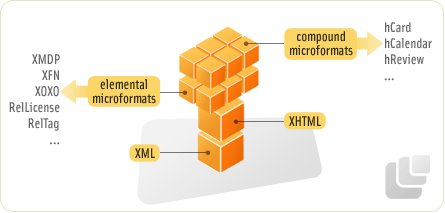
By now you’ve probably heard of microformats and wondered what they are, exactly. Officially, they’re a set of simple, open data formats built upon existing and widely adopted standards that allow web sites to be coded for humans first and machines second. Instead of throwing away what works today, microformats intend to solve simpler problems first by adapting to current behaviors and usage patterns (e.g. XHTML, blogging). Some call this movement the schematic web and its implications are potentially significant. The diagram above illustrates the technical components and layers of Micoformats.

Bill Gates and Tim O’Reilly speaking on this subject at Mix06.

While discussing “Web 2.0″, Tim O’Reilly just said:

…the semantic web is really taking off with the use of microformats.

And in response, Bill Gates said:

We need microformats and to get people to agree on them. It is going to bootstrap exchanging data on the Web…
…we need them for things like contact cards, events, directions…


I have been struggling with understanding microformats, those mysterious formats built in XHTML that several folks have been talking about passionately: promising everything from better search engine visibility to better structured code to a realization of true semantic markup. The reason for my struggles was that there were few actual examples of their utility, hCard, hCalendar, and Bud Gibson’s xFolk being interesting exceptions.

I do believe Microformats will become important because they involve all the same sorts of principles that make up Web 2.0. For example: if every web publishing tool wrapped reviews of books with certain kind of tagging information explaining that they were then people could build new tools that aggregate and provide information based on all the book reviews on the web. Imagine Amazon reviews pulled in and sorted from all over the internet. Or imagine being able to easily download any event on a website to your own calendar. Microformats open up opportunity for publicly displayed information to get into the places where it can do the most good for end users.

Microformats are about using the standards we all know and love to convey as much semantic meaning as possible. Think of them as semantic best practices. They use current XHTML tags such as address, cite, and blockquote and attributes such as rel, rev, and title to create semantically appropriate blocks of code. Microformats are great because they are both usable and elegant—and all you need to do to get started with them is familiarize yourself with the best ways to apply the tags and attributes you already use.

Brief Microformats Primer

A. Microformats Defined
  • A way of thinking about data
  • Design principles for formats
  • Adapted to current behaviors and usage patterns (“Pave the cow paths.”)
  • Highly correlated with semantic XHTML, AKA the real world semantics, AKA lowercase semantic web, AKA lossless XHTML
  • A set of simple open data format standards that many are actively developing and implementing for more/better structured blogging and web microcontent publishing in general.
  • An evolutionary revolution
  • All the above
B. Microformats Principles
  • Solve a specific problem
  • Start as simple as possible
  • Design for humans first, machines second
  • Reuse building blocks from widely adopted standards
  • Modularity / Embeddability
  • Enable and encourage decentralized development, content, services
C. Microformat Examples
 

Copyright © 2009 by Michael Moir. All rights reserved.